Skip to content
ColumbusGarage Door ExpertsOpen 24/7 (289) 512-0639
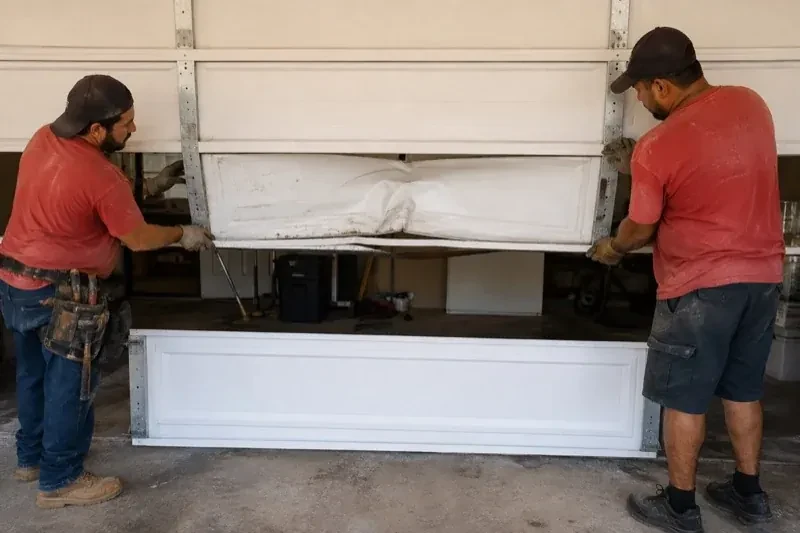
Two people holding a dented lower garage-door section above a separate white panel resting on the ground. — Garage Door Panel Replacement, Oshawa

Repairs · Oshawa

Garage Door Panel Replacement

From outside, the horizontal groove between two sections now steps sideways by a centimetre. One section has shifted on its hinges after a roller jumped the track, and on the way down the door catches at exactly that point.

In plain words

Not all sections are equal. The bottom section carries the brackets that anchor the lift cables, the seal that meets the floor, and most of the abuse from ice, salt and bumpers. The top section takes the pull of the opener arm and often carries a strut. The intermediate sections mostly carry hinges and rollers. Which position is damaged shapes the whole job: a bottom section means releasing spring tension before the brackets come off, a top section means dealing with the opener bracket and top fixtures, and a middle section is the most straightforward exchange. The technician plans the visit around that position.

Sound familiar?Oshawa

The call
The top section has developed a bend where the opener arm pulls on it. On the way up it flexes visibly, the door hesitates near the top of its travel, and daylight shows through the joint below it when the door is closed.
NextHow the visit goes

Garage Door Panel Replacement · Oshawa

How the visit goes

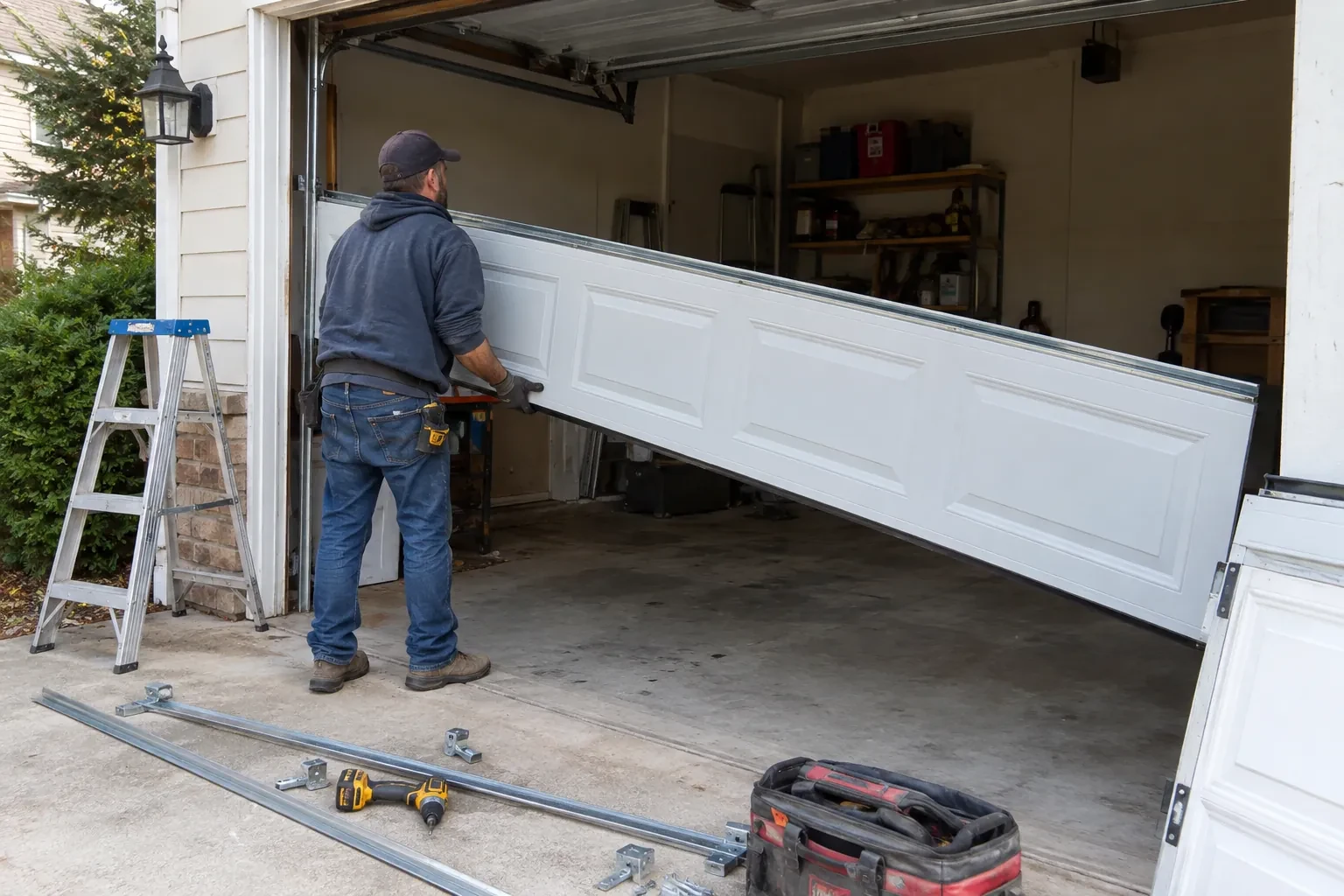
Person tilting a white paneled door section into the opening, beside metal track pieces, a drill and a tool bag.
  1. Scene 1

    One section, or is it time for the whole door?

    A single damaged section on a door that is otherwise sound is a clear case for a section. The picture changes when damage crosses two or three sections, when rust has taken hold along more than one edge, when older sections have warped or delaminated, or when the design is no longer produced. It also changes when you would like insulation, windows or a different look that only a new door provides. The technician lays the two options side by side, describing what each includes and what you would have afterwards, so the choice is made on the whole door's condition rather than on the one dent that prompted the call.

  2. Scene 2

    Bottom section: brackets, seal and cables

    A new bottom section arrives bare, so its working parts are fitted on site. Bottom brackets are bolted to each end, with the cable attached and the safety tab in place, and a roller set in each bracket. The seal retainer is fixed along the bottom edge and a new astragal is slid into it so the door meets the floor evenly. The lift cables are laid over the drums, the springs are wound back to the correct number of turns for the door's height, and the set screws are tightened. The door is then eased off the floor by hand to confirm the cables are seated and even on both sides.

  3. Scene 3

    Keeping ice away from the bottom section

    Since a bottom section frozen to the slab is the commonest way one gets bent, a few winter habits protect the new one. Sweep snow away from the outside of the door before it turns to slush and freezes under the seal. A light wipe of silicone on the new astragal helps it release from ice. If the door refuses to move on a cold morning, free the seal from the floor with warm water or a scraper before running the opener rather than letting the motor pull against it. A well-fitted bottom seal also keeps meltwater from wicking under the door in the first place.

In the van

  • Nylon or steel rollers
  • Matching replacement section
  • Horizontal reinforcement strut
  • Self-tapping stile screws
  • Bottom brackets with cable tabs

What shapes the quoteColumbus Garage Door Experts

How many sections are affected
One section is the base case. Two adjacent sections add a second unit and its hardware but share the setup; three or more usually prompts a comparison with a complete door so you can weigh both.
Special-order handling and freight
Made-to-order sections travel from the factory or distributor, and a long or glazed section needs careful handling in transit. Freight and order handling are shown as their own line rather than folded into labour.
Which position the section sits in
A bottom section includes releasing and resetting spring tension and fitting brackets and seal; a top section involves the opener bracket and top fixtures; a middle section is the plainest exchange. The position shapes the labour.

FeesSame any hour

Have it ready

Before you call · 0 / 3

(289) 512-0639

Frequently asked questions

How long does it take to get a replacement section?

Sections are made to order for a specific model, size, position and colour rather than kept in stock, so there is a lead time from the manufacturer. It varies with the maker, the colour and the season, and the technician confirms the expected timing when the order is placed. In the meantime the door is left in a safe state, either in normal use or braced and closed, depending on the damage.

What is a strut, and does a new section need one?

A strut is a horizontal steel stiffener fastened across the inside of a section to keep it from bowing. Wide doors, top sections where the opener arm pulls, and bottom sections that take knocks are the usual places for them. If your damaged section had a strut, the new one gets a straight strut refitted or replaced. If a top section bowed because it never had one, adding a strut is part of putting it right.

My door is insulated. Does the new section need the same insulation?

It should. Insulated sections come in different thicknesses and core types, and the replacement needs to match yours so the joints line up, the hinges sit at the right depth and the weight stays consistent with the springs. Mixing an insulated section into an uninsulated door, or the reverse, generally means a step at the joint and a change in balance. The technician reads the thickness and core type from the door before ordering.

Oshawainformation

DurhamOntario

Garage Door Panel Replacement · Columbus

Town
Oshawa, Durham
In business
21 years
Hours
Open 24/7
Nights, weekends and holidays, same fees
Visits
On-site assessment preferred. Request a visit or call.

2021 census: what it means at the door

Every square is one home in a hundred.

  • 59 in 100 homes · older homes
  • About 59% of homes in Oshawa were built in 1980 or earlier, according to the 2021 Census.Original openers in older neighbourhoods often predate photo-eye sensors and rolling-code remotes. Bringing one up to date means a quieter motor, sensors that stop the door for a child or pet, and remotes that cannot be copied from the driveway, all installed in a single visit.
  • Single-detached houses make up about 56% of homes in Oshawa (2021 Census).Where housing is mixed, the doors are mixed as well: wide insulated doubles, narrow singles in rows and the occasional rolling door on a small commercial unit at the corner. Spring type, cable length and opener strength are matched to each door individually.

Source: Statistics Canada, Census Profile

Nearby

Open Oshawa in Google Maps

On-site assessment

Request a visit.

From outside, the horizontal groove between two sections now steps sideways by a centimetre.

(289) 512-0639, open 24/7.